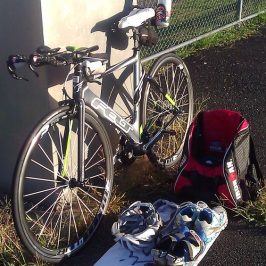
Having multiple races on your calendar is exciting and motivating. Maybe you have a 10k leading into a half marathon, several triathlons throughout your season, a major goal race followed by another event a few weeks later, or a runDisney challenge that consists of two to four days of races on back-to-back days. But racing multiple events requires more than simply getting through each race and then starting the next training block. How you manage recovery when racing multiple events will be a deciding factor on how well you do in your consecutive races.

Recovery Becomes Part of the Overall Race Strategy
How you recover after a race affects how well you can train, how you feel going into the next race, and ultimately how you perform when you get to the starting line again. If you ignore recovery, then you won’t get the most out of your training. The goal is to recover appropriately so that you’re ready for what comes next.
Using various recovery techniques will help you recover better and get the most out of your training and help you be ready for your next race.
Not Every Race Requires the Same Recovery
One of the biggest mistakes athletes can make when racing multiple events is treating every race the same. A hard 5k doesn’t place the same demands on the body as a marathon. A sprint triathlon isn’t the same recovery process as a Half Ironman.
Even two races of the same distance can require different recovery depending on how you race them. A few things consider are:
- Were you racing all out?
- Was the race part of your training?
- Was it a tune-up for a larger goal?
- Did you have a good race or did you find yourself struggling ore than expected?
Your recovery also depends your physical age, your athletic age, and what races are next on your schedule. If you have another race in three weeks, your training and recovery need to be coordinated. You may not need to take the same approach you would after a race that marks the end of your season. That’s why there isn’t one universal number of recovery days that applies to every athlete and every race.
Recovery Starts When the Race Ends
Recovery isn’t something that begins the next morning, but rather it starts as soon as you cross the finish line.
After a race, your priorities are giving you body what it needs to begin repairing and recovering, which includes:
- Rehydrating
- Refueling
- Stretching and loosening up
Give Yourself Time Before Returning to Normal Training
It’s easy to look at a training calendar after a race and think “ok, what’s next?”. That’s particularly true when another event is coming up. But physiology should take precedence over the excitement of the next race.
You may feel good a day or two after a race and assume you’re ready to jump right back into normal training, but it doesn’t mean you’re ready for your usual volume or intensity.
Early recovery should give your body an opportunity to absorb the stress of the race. Depending on the athlete and the event, that might mean walking, an easy swim, an easy spin on the bike, or a recovery jog. It could also mean taking a complete rest day. The important part is that you’re not trying to prove that you’re recovered by immediately returning to hard training.
Recovery Doesn’t Always Mean Doing Nothing
There’s a tendency to think of recovery as complete rest, but it doesn’t always come to that.
Easy movement can help you transition back into normal activity, particularly when you’re dealing with the stiffness that often follows a race. But there’s a significant difference between moving easily and trying to squeeze another quality workout into a week when your body is still recovering.
The intensity and volume of your training should reflect where you are in the recovery process. This is especially important when you have another race approaching. The goal is not to cram missed workouts into the days following a race. You can’t make up for training you didn’t do before the event by piling more work onto an already stressed body.
Look at the Next Event Before Deciding What Comes Next
This is where racing multiple events gets more complicated.
Your recovery plan shouldn’t be based solely on the race you just finished. It should also take into account the race that’s coming next. Racing a half marathon and then a 5k three weeks later will require a different approach from racing an Ironman followed by another long distance race six weeks later. Recovery needs and training will be very different between these two scenarios.
The same is true if you’re racing a half marathon as a goal event as opposed to using a half marathon as a long run or tune-up for a longer goal race.
The next race is what changes the equation. Take a big picture approach. So instead of asking “how long should I recover from this race?” it can be more useful to ask “what do I need to be ready for the next race and what do I need to do between now and then?”
Don’t Forget Nutrition and Sleep
Training often gets the most attention when athletes think about preparing for a race. But recovery doesn’t happen only because you changed the workout on a calendar. Your body needs adequate energy and nutrients to recover from the demands of racing.
Continue paying attention to your daily nutrition, don’t abandon your normal eating habits. Replenish carbohydrates, consume adequate protein, stay hydrated, and eat enough to support the recovery process.
Sleep matters, also. A few nights of poor sleep can make it harder to recover. If you’re racing frequently, sleep becomes an important part of managing the cumulative stress of training, racing, work, travel, and everyday life.
Recovery is not what happens between workouts. It’s what happens in between all of the demands on your body.
Pay Attention to How You’re Feeling
Pay attention to how you’re feeling when you return to training. Some fatigue and soreness are normal after racing. But persistent pain, unusual fatigue, changes in your normal performance, or symptoms that are improving deserves attention.
This is particularly important when races are close together It’s easy to assume that feeling less than your best is part of having a busy race schedule. Sometimes it is, but other times it’s a sign that you need more recovery or that you need adjustments somewhere else.
When Races Are Close Together
You can’t always maintain a full training load, race hard every weekend, and expect to recover completely between events. Something needs to change.
When you have several races planned, then you might have to do one or more of the following:
- Reducing training volume
- Modifying intensity
- Changing the focus of certain workouts
- Changing the priority or goal of one of the events
If you have several races lined up, you need to know which races are the primary goal A races and which are the lower priority B and C races. Sometimes one race is there to test fitness, sometimes it’s part of a build up towards a longer race. And sometimes it’s simply an opportunity to gain race experience.
With your race priorities set, training can then support those goals rather than trying to peak for every single race simultaneously.
Think About the Entire Season
When you’re racing multiple events, it’s easy to become focused on one finish line at a time. But your season is bigger than any single race.
The race you just completed affects your recovery. Your recovery affects your training. Your training affects your next race. And that race affects everything that follows. It’s a cycle that that needs to fit together as part of a larger plan.
Remember that there isn’t a prize for recovering the fastest.
Your goal is to do well in your races, so you want to arrive at your next starting line prepared for the race you’re about to run, not still trying to recover from the last one.
Racing Multiple Events
If you have several races close together on your calendar, such as the runDisney races, Ironman and Half Ironman races, or several fall half marathons, your training shouldn’t be viewed as a series of separate race plans. The events and training need to work together and coordinate with each other.
Your training should account for all of the races you’re targeting, the demands of each race, and the recovery you’ll need between them.
Ready for coaching that looks at the big picture and prepares you for multiple races? See how we can help.
Share the love! - - >